|
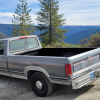
I live near the Eastern Sierra Mountains that descend down to the valley in about 30 miles of rolling hills taken at highway speeds. My truck feels like it is really hurting itself slamming in and out of OD. You can feel the hits right through the chassis.
I started reading (now we're in trouble!) the AOD Service Manual on this site and found this bit in the Troubleshooting section: Symptoms:Shift clunk when throttle is backed off
Has anyone else tried to perform this adjustment? How to verify this is really my issue and I'm not just looking for something to tinker with?
86 F150 302efi
|
|
first of all... is this truck new to you? if not, is this symptom new?
|
|
Administrator
|
Not to mention he doesn't have a carburetor, so he has the wrong diagnostic chart.
Bill AKA "LOBO" Profile
"Getting old is inevitable, growing up is optional" Darth Vader 1986 F350 460 converted to MAF/SEFI, E4OD 12X3 1/2 rear brakes, traction loc 3:55 gear, 160 amp 3G alternator Wife's 2011 Flex Limited Daily Driver 2009 Flex Limited with factory tow package Project car 1986 Chrysler LeBaron convertible 2.2L Turbo II, modified A413 |
|
In reply to this post by mat in tn
OK thank you, I see where I was on the wrong page.
![]() My symptom still matches that one described for the carb'ed AOD. Hard shifts when coming off throttle after cresting a hill and starting the descent above 55mph. The truck has had this issue for a very long time, more than 10 years but I moved out of the mountains so I wasn't reminded of the problem until I rolled it up the mountains a couple of weekends ago. I wanted to start to address some of this trucks issues since I plan on keeping it for a long time.
86 F150 302efi
|
|
Administrator
|
Ok, on yours, the cable is up on top of the throttle body, originally under a plastic cover. A hard downshift, and probably a late, hard upshift is caused by the cable being too short.
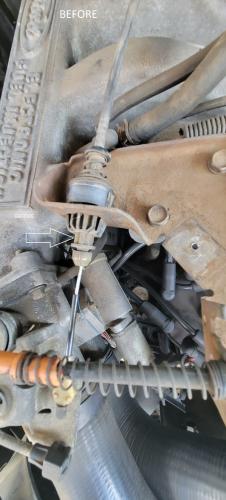
Since there is no cable adjustment, you have to move the cable casing. To effect the lengthening of the cable involves moving the outer casing toward the pin that the cable snaps on to. There is a large spring loaded section near where the TV cable attaches to the throttle body bracket. There is a large pressed in detent latch on the part that attaches the cable to the bracket. Holding the cable so it can't move back, release this latch by prying it up until you feel the cable casing want to push away from the bracket, push the casing in until you can re-latch it one notch in. This has now "lengthened" the cable one notch. Drive the truck and evaluate the shift feel, if it is good, reinstall the cover. Basically cable casing toward pin = earlier, softer shift, away from pin = later harder shift, just opposite of the carburated rod.
Bill AKA "LOBO" Profile
"Getting old is inevitable, growing up is optional" Darth Vader 1986 F350 460 converted to MAF/SEFI, E4OD 12X3 1/2 rear brakes, traction loc 3:55 gear, 160 amp 3G alternator Wife's 2011 Flex Limited Daily Driver 2009 Flex Limited with factory tow package Project car 1986 Chrysler LeBaron convertible 2.2L Turbo II, modified A413 |
|
yes, the cable adjustment is very important. if it is too long(loose) it will apply holding pressure on the clutches later and will allow the clutch to slip. whereas if it is too short(tight) it will hold more pressure than required per the load on the engine and harsh shifting can be felt. mis adjusted tv cables have been the cause of MANY aod failures. too loose or disconnected and it will burn the clutches quickly and that is the real weak link of the aod. too tight for the most part is just uncomfortable. I try to set them where I can just feel the positive gear change and no more. That should bring in od at 40-45 mph. of course the more throttle used the later the upshift.
proper adjustment requires a test gauge attached to the tv port on the rear passenger side of the transmission case. pressure reading is spec'd at 0-5 psi at idle. I go for 4-5 psi. I want as little slip as comfortably possible and downshift on tip in responsive. |
|
Thank you Mat in Tenn and Lebaront I will carefully walk through that cable adjustment.
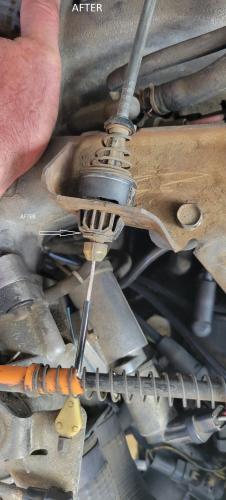
I'll also provide some before and after cable position photos with behavioral results, as much for myself as the the community.
86 F150 302efi
|
|
I agree with what was already said: too little TV pressure and bad things can happen to your AOD quickly. If anything, err on the side of more TV pressure rather than less.
But your symptoms sound like you may actually have too much pressure. I adjusted my Lokar TV cable to have a full pull of the TV cable at full throttle. It has been adjusted that way for about 7 years now and I haven't had any issues.
Lucille: 1985 Ford F150 XLT Lariat
*Colors: Dark Canyon Red exterior, Canyon Red interior *Engine: 5.0, CompCams 31-230-3, "Thumper" E7 heads, Edelbrock Performer intake, Autolite 4100 carburetor, DuraSpark II ignition, Thorley Tri-Y headers, Flowmaster dual exhaust, H-pipe. *Drivetrain: AOD transmission, 3.55 gears, 2wd. |
|
I found this crusty old TV formatted video that I believe describes the factory setting of the cable and I will follow that procedure.
86 F150 302efi
|
|
So I got time to try this cable adjustment.
I may have an issue in that I think the cable is at it's limit WRT the adjustability OR perhaps my 'idle' screw is mis-adjusted which would pull the cable too. I found that the little lock collar that is the key to the cable adjustment seemed to be frozen in place. That is because it has probably not been disturbed in decades. In the video above the guy just grabs it and the thing popped up for him but he must have had some magic fairy dust he sprinkled on it 1st because mine needed a fight. The retaining tabs are at the bottom of the collar and need to be pushed inward then the chemical bond created by dust and time needs to be broken after that. A quick drive afterwards didn't show any appreciable difference BUT didn't reveal any problems with the adjustment I made. I'll have to go drive it in the hills later. ![]()
86 F150 302efi
|
|
wow. that's a big adjustment. how much slack was in the cable before you made the adjustment? I'm a little concerned about the condition of the cable itself. at the lower end there is a corrugated boot covering a spring. there is a throttle valve spring inside the trans to default to high pressure and the cable mounted spring is there to hold it in check. kind of like arm wrestling. how smoothly the cable operates while disconnected completely can tell a lot. in some cases, the cable can have a lot of drag within it caused by corrosion. not real common here in TN but it happens. however, your cable adjustment "looks" tight.
|
|
Thanks Mat, I think that you are on point suggesting that the adjustment is not correct --> yet.
The upshifts moved up the RPM range which actually feels pretty good, the shifts themselves are now firm'ish instead of nearly imperceptible like they were before (no tach so ya gotta go by feel and the truck is pretty quiet). I wish I could keep these new higher up shift points but also restore the smoothness. Previously it seemed to be shifting up too quickly. While that may be good for mileage made for a very sluggish truck that you had to constantly force it to lower the gear with your foot to get going, which was an ungraceful way drive and probably killed off any gas savings anyway. The bang'ing downshift when I let off throttle is still happening and seems to be related to the proximity of the current shift point at the moment traffic forces me to suddenly drop throttle. It doesn't do it every time I cut throttle. I previously thought that it was only happening when coming out of OD but I think I'm going to have to toss that idea. I will get the cable disconnected from the throttle body (there is a trick to getting that cable connector 'hat' to release from the ball, I'll figure it out) and ensure that the movement all the way to the transmission is correctly pulling the cable without drag and it is getting fully down to it's closed position. Then I'll re-tension the cable again. A little lube in the cable probably wouldn't hurt either.
86 F150 302efi
|
|
is this a completely original setup or has the aod been rebuilt at any time?
|
|
the reason i ask about it possibly having been apart is there happens to be a quirk in the casing of aod designed transmissions. there is a support plate about midway between the reverse drum and the planetary assembly which gets held in place by a snap ring it has the ability to rotate the opposite direction of force whenever the force direction changes the drive shell swaps it position from one stop to another. they are intended to have a load spring in place which holds the drive shell against one stop and absorbs the inclination to rotate back and forth. you guessed it; it's called the" anti-clunk spring". most noticeable when downshifts occur. rarely ever otherwise because stationary parts are loaded under acceleration. this may be far out of left field unless it has been apart before.
|
|
Administrator
|
Good point Mat! That spring can be a pain to figure out if you didn't pay attention to it's location/orientation during disassembly.
Bill AKA "LOBO" Profile
"Getting old is inevitable, growing up is optional" Darth Vader 1986 F350 460 converted to MAF/SEFI, E4OD 12X3 1/2 rear brakes, traction loc 3:55 gear, 160 amp 3G alternator Wife's 2011 Flex Limited Daily Driver 2009 Flex Limited with factory tow package Project car 1986 Chrysler LeBaron convertible 2.2L Turbo II, modified A413 |
| Edit this page |